NEW STATESMAN
Scottish National Party Leader and Scotland's First Minister, Alex Salmond, addresses the SNP conference. Photograph: Getty Images.
Posted by George Eaton - 25 October 2011 15:43
While Westminster is fixated on the EU, Scotland is moving ever closer to independence.
While the Tories have been warring over whether to hold a national vote on EU membership, Alex Salmond has been quietly devising his strategy for a different referendum. As the SNP leader confirmed at his party's conference last weekend, the ballot paper will contain two questions. The first will be a straight yes/no question on Scottish independence, the second will be on full fiscal autonomy or "devolution max" (devo max).
Aware that he may not be able to win a majority for independence, Salmond is attempting to ensure that the SNP ends up with a consolation prize. But no one should underestimate how radical a step fiscal autonomy would be. Scotland would win complete control over spending, borrowing and taxation, leaving Westminster in charge of foreign affairs and defence. In an ingenious move, Salmond is attempting to turn the SNP into the party of independence and the party of devolution. The distance between the two is smaller than some imagine. An independent Scotland would retain the Queen as its head of state, British military bases (although the Trident subs would go) and the pound until, in Salmond's words, "it was in Scotland's economic advantage to join the euro" (in other words, indefinitely).
However, there is every reason to believe that Scotland will vote for full independence in the second half of the five-year Holyrood parliament. The SNP has already amassed a £1m campaign war chest and the polls are moving its way. A ComRes survey published on 15 October showed that 49 per cent of Scots now favour independence, with just 37 per cent opposed. Scottish Lib Dem leader Willie Rennie posed the question: "What if devo max got 99 per cent 'yes' and one per cent 'no' in the vote while the independence option got 51 per cent 'yes' and 49 per cent 'no'?" But Salmond has already confirmed that a slim majority for independence will trump a large majority for devo max. A brilliant politician and strategist, he will wait until discontent with the Westminster coalition is at its height before calling a referendum.
Labour and the Tories, leaderless as they are in Scotland, are not even close to devising a strategy to combat Salmond. After the SNP's remarkable victory in May, David Cameron vowed to defend the United Kingdom with "every fibre in my body". But we've seen little evidence of that so far. As for Ed Miliband, he has largely avoided the subject since forgetting the name of one his party's leadership candidates (Ken Macintosh), even though Scottish independence would automatically strip his party of 41 seats. For now, all the momentum is with Salmond and the SNP. This must change. And soon.
Tuesday, 25 October 2011


English 'Til I Die - Al Jazeera World - Al Jazeera English
English 'Til I Die - Al Jazeera World - Al Jazeera English
New series on al Jazeera examining the rise of the fascist English Defence League.
New series on al Jazeera examining the rise of the fascist English Defence League.
Monday, 24 October 2011
Scottish capital hails heroes who signed up to stop fascists

Volunteer nurse Annie Murray lays a wreath at the Spanish Civil War memorial in Princes Street Gardens in 1980
Published on Friday 14 October 2011 12:06
THE Capital will today mark the 75th anniversary of Scottish involvement in the Spanish Civil War.
Almost 600 brave Scots volunteered to fight the fascists for the republican cause during the 1936 to 1939 battle, many of them from Edinburgh who had never left the city before.
Around one third – up to 200 – lost their lives, and there are now no living Scottish volunteers.
A commemoration ceremony was to be held this afternoon at the Spanish Civil War memorial in East Princes Street Gardens, to which people were invited to bring flowers in the red, yellow and purple of the Spanish republic.
An event will also be held tonight to commemorate those who paid the ultimate sacrifice after leaving Scotland to fight – or nurse – in the war.
Co-organiser, Leith-based author, Daniel Gray said: “The people who fought in the war are heroes who deserve to be talked about and remembered. We can learn a lot from them – they were extremely gallant and bold people, and really inspirational.”
The Spanish Civil War started in July 1936 with large numbers of Scots travelling to Spain in October 1936. The conflict ended in April 1939. Today’s commemorative events focus on the start of the Scots going to Spain.
Tonight, Stories and Songs of Spain will take place at the Pilmeny Youth Centre in Leith from 7pm. The free event will feature live anti-fascist Spanish music from Gallo Rojo and a rare screening of a documentary, Scotland and the Spanish Civil War.
Daniel Gray will also read from his book, Homage to Caledonia, in which he traced the stories of the Scots who volunteered.
Among his discoveries were letters from 37-year-old Edinburgh shoe repairer Harold Fry’s wife following his death on the battlefields.
Mrs Fry, who was left a widow with a month-old baby her husband had never seen, wrote: “His experience of fascist methods of warfare and their brutal treatment of prisoners behind the lines only helped to strengthen his determination to carry on the fight until Franco, Hitler and Mussolini were beaten.”
City nurse Annie Murray was one of only a handful of Scottish women to serve in the war.
She left her career at the Royal Infirmary to volunteer in the British Medical Aid Committee. Near Barcelona, Annie saw young children blown to pieces by bombs dropped by Italian planes, disguised in sweet tins.
In a letter to her sister Agnes, she said: “The poor little mites of children picking up what they took to be the long-desired chocolate and quickly opening them were suddenly left handless, their faces burned beyond recognition.
“Nothing could surely be more brutal. What a bloody awful war this has been.”
Co-organiser of the commemorative events, city councillor Gordon Munro, said: “The contribution these people made was immense.
“You’re talking about ordinary working men and women going across to Spain and fighting.
“We were conscious that their contribution needed to be marked and remembered.”
laura.cummings@edinburghnews.com
http://www.scotsman.com/edinburgh-evening-news/edinburgh/around-the-capital/capital_hails_heroes_who_signed_up_to_stop_fascists_1_1910936#.TptMahT9MwM.facebook
Wednesday, 10 November 2010
Starting as we mean to go on. Take the class war back to the enemy.

Statement from Not A Dinner Party on the student Siege of Tory HQ at Millbank Tower.
THIS IS JUST THE BEGINNING
Six months in to the ConDem government and their open declaration of war on the poor, the disabled, the working class and indeed everyone who isn't responsible for the crisis of finance capitalism (ie imperialism) and the first major protest in London ends up exactly where it should, with thousands of students laying siege to the tory Party HQ. The best possible start to what has to be a sustained campaign of militant resistance to what in reality is a very weak and divided government, but one with the arrogance of being formed directly and unapologeticly from the most priviliged and callous section of the ruling-class, people who beleive it is their birth right to rule and their ancestral right to privilige at the expense of all else.
Todays action is a lesson is the direction the anti-cuts movement has to take if it is to be successful. While the tories are hell-bent on taking us back to the 80s excesses of Thatcherism, we cannot afford to repeat the mistakes that the Left and the Labour Movement made then. Waiting for Labour is of course out of the question. The ConDem regime is after all continuing a program that was initiated and laid out by the last government. Labour's only concern is not that the tories are going too far, but that they are doing it too fast. So far there has barely been a peep out of the Labour Party and nor will there be. But you can bet they will be falling over themselves to denounce any and all effective militant resistance to the cuts.
And nor can we follow the same lefty routine of marching from A-B inb town centres, demonstrations and rallies that do nothing but annoy weekend shoppers and are completely ignored by both the media and of course by the government - safety valves for an innefectual and impotant "Left".
This struggle needs to take on board the example of the protests that have rocked Greece and France. And it needs to learn from our enemies. Over the last year the fascist English Defence League has built a mass street movement that can mobilise thousands - and done so largely through utuilising social-media specifically Facebook. Using such sources the far-right have been able to very successfully spread their message, organise at short notice and make contacts and develop new networks amongst tens of thousands - and that influnce extends well beyond those singed up on their Facebook pages - the rumours and claims they put out spread like a virus and are picked up and repeated by millions. There is no reason at all why militant progressives cannot utilise similar methods.
In the early months and years of the Blair New Labour administration, another section of the Right, this time essentially the extra-parliamentary wing of the tory party, mobilised tens of thousands through the Countryside Alliance, not just in demonstrations and protests but also in motorway blockades. Likewise the rightist Fuel Tax Protests effectively shut down the country's fuel distribution network with illegal blockades of fuel refinaries, storage facilities and motorways, and maintained huge public support even while petrol stations ran dry, shop shelves emptied and schools and hospitals were threatened with closure.
These actions were most often illegal. 18 years of the Thatcher offensive against the organised working class left the trade union movement crippled by laws that effectively outlawed any effective industrial struggle or shows of solidarity. Not only did New Labour not rescind these laws, they added to them with the most draconian "anti-terror" legislation that has essentially given the state the legal means to criminalise and shut down any form of protest. But this has not deterred the Right. It did not deter the Countryside Alliance, the anti-Fuel Tax protesters and it certainly hasnt hinderd the EDL. But you will be hard pressed to find any Union leader (with one or two possible exceptions) who would for a second ever contemplate risking sequestration, crippling fines and imprisonment for calling for and leading any effective fightback.
So it is a given that really any form of protest, no matter how seemingly innocent or mundane, is "illegal" now. And it is also a given that the old methods of protest have failed. They didnt stop Thatcher in the 1980s - the only "traditonal" force that came close was the Miners - and the price of their defeat was their complete destruction, as a Union, as an industry and as a community. And if two million marching through London couldnt influence a Labour government to think twice about engaging in an illegal war, then what makes anyone beleive any number marching, whistleing, dancing, wearing costunmes, banging srums and shrieking the same old tired slogans, will have any influence on a tory government that regards such people as the scum of the earth anyway?
The one victory we did have was over the Poll Tax, it was an attack on ordinary people every bit as callous and cynical as what we are seeing now. And the protest succeeded because it went outside and beyond the usual forms. It involved ordinary people who organised themselves and based their action on what they felt was possible and effective in the area they were and with the numbers they had. While most people know of the legendary Battle Of Trafalgar Square of 1990, something that will most likely be eclipsed inthe coming struggle, what most people who werent around at the time dont know of is the hundreds of protests that took place outside scores of town halls often involving thousands of people, and very often ending with council chambers being stormed. Bailiffs offices were trashed, Conservative Clubs attacked and for the first time in years, there was a sense of panic amongst the politicians and a real sense that would could win amongst the people. Millions refused to pay, the Poll Tax was dropped and Thatcher forced from office.
But this government, for all of its Thatcherite arrogance and contempt, is actually very weak and very divided. It can be beaten. But the struggle needs to get "personal". Would 1 thousand people marching through a town centre make any impact? How about a thousand people marching on the constituency office of the local tory or Liberal Party? A thousand marching on the surgery of a MP? A thousand marching on the home of a MP? A thousand taking over the council chamber when they annouce their cuts.
There is no doubt that the anger and militancy of todays protest has sent a ripple of shock and anxiety through many amongst the enemy tonight. After only 6 months in power, and the first major protest in London against their policies, they have already witnessed a minor taste of the real, deep and growing anger that is ready to explode.
And by taking their anger directly to the HQ of the enemy they wil have acheived more than a hundred town centre marches from park A to park B to listen to Union and Labour hypocrites proclaim platitudes and promises they have no means or intention to fulfill.
If this government inlficts pain and fear - then those responsible, those who enforce it and support it, from top to bottom, must be made to understand what pain and fear really means.
Political Response to Economic Crisis in Ireland
Political Response to Economic Crisis in Ireland
Sinn Féin offers a better way
By Nicky Dempsey
SOCIALIST ACTION
Sinn Féin has published its response to the Dublin government’s threatened plans to cut public spending once more in its Budget for 2011, There Is A Better Way. The Fianna Fail/ Green coalition in government has outlined planned further cuts totalling €6bn in both capital and current spending, including welfare payments to the poor. This would bring the total level of ‘fiscal tightening’ to €20.6bn since the end of 2008, which is now equivalent to 13.1% of GDP. For comparison the British government’s current plans – among the most draconian of any major European country- amount to 9.2% of GDP.
The Sinn Féin response stands in stark contrast to the bourgeois parties across Europe who have used the recession and ensuing fiscal crisis to launch an attack on the social welfare gains built up since WWII. The SF policy has three key components. First, is to shift the burden of taxation from the poor to a rich in a series of measures including higher income and wealth taxes for higher earners and the rich. Secondly, reform of the tax system in what the party calls a ‘financial stimulus’ to redistribute incomes towards the poor and low-paid. But the largest component of the policy is a €7.5bn government investment package in infrastructure and other areas such as early childcare, which is estimated to create 160,000 jobs. This would go some way to addressing the collapse in investment which more than accounts for the entirety of the Irish recession.
The other major parties in Ireland have all signed up to the policies of the Dublin government in the South while Sinn Féin is the only party to consistently oppose the same agenda of the British government in the North of Ireland. In Dublin, the FF-led government had been hoping to co-opt the other parties, Fine Gael and Labour, into explicitly supporting their further attacks on the living standards of workers and the poor. Given that both actually propose very similar measures (with Labour simply calling for a ‘rebalancing’ of the measures towards tax increases), there was actually the basis for a de facto grand 4-party coalition, including the junior coalition partners the Greens.
However, FF’s slump in the polls, down to 18% in one poll in October, from 41.6% in the 2007 general election, made the nominal opposition parties more cautious. The caution turned to outright hostility for purely electoral considerations as the government has been forced by High Court order to hold a long-postponed by-election in Donegal, with others to follow in the New Year. The legal case was itself a victory for Sinn Féin, with the other parties content to allow the government to continue in office despite dwindling parliamentary and popular support. The consequence is that the government is likely to fall early next year and may well call an early general election. Neither Fine Gael nor Labour saw any electoral advantage in propping up Fianna Fail, even while they agree on the substance of further cuts.
Saving The Nation
Fianna Fail, which styles itself ‘The Republican Party’, made the appeal to other parties to support its Budget on the grounds that a failure to act would lead to a ‘loss of sovereignty’ as the ECB/EU/IMF are waiting in the wings to impose further, even more drastic cuts. In fact the government’s own policy now makes this outcome more than possible. Financing through the bond markets is no longer possible as long-term interest rates approach 8%, compared to just over 2% for Germany. While the ‘austerity’ policy has led to a collapse in economic activity and a widening of the public sector deficit, a uniquely generous bailout of bank bondholders means that respected commentators believe the cost to taxpayers will be approximately €76bn, more than 8 times the size of cuts threatened in this December’s Budget and equivalent to €17,000 for every woman, man and child in the State.
The effect of the guarantee is to provide an enormous transfer of taxpayer funds to bail out primarily German, British and French banks, the main holders of debt in Irish banks. While the EU and ECB have insisted on this when burdening Greek workers and the poor with increased debts, the Dublin government initiated this policy itself. The only conceivable explanation is that by bailing out the bondholders, the latter will not foreclose on the banks and their property speculator customers. These two groups, bankers and property speculators, are the political core of the Fianna Fail alliance, even though for historical reasons, its electoral support derived from urban workers.
This subservience to European finance is the flip-side to the government’s prostrate position before the interests of US industrial and commercial capital. This is codified in the lowest corporate tax rate in the OECD area, 12.5% compared to 39% for the US and Japan, 30% for Germany, as well the indulgence of myriad schemes, which reduce the effective rate of tax to below 2%.
The policy response to the crisis, to enrich these foreign capitals by depleting the resources of the workers and the poor failed to reckon on the finite level of the latter, and the voracious appetites of the former. Usually, in a Western European economy of the standard type, the domestic bourgeoisie, crushed by the impositions on its own activities and the damage done to its domestic markets would rise up and remove such a government. But Ireland is not a standard type of Western European economy. While one quarter of the country remains a direct colony of Britain, the remainder retains the distorted social structure of the recent colony. Most especially, outside of the dominant layers in banking and property speculation, the bulk of the Irish bourgeois class is comprised of globally insignificant capitals, with owners of fast food outlets, bookmakers and publicans to the fore in IBEC, the main employers’ federation. There are literally only a handful of Irish-owned companies that compete in global markets.
So, when in 2009, policy in the advanced capitalist countries was focused on measures to boost domestic demand, tax breaks, employmentsubsidies and so on to ensure the survival of indigenous capitalism, no such measures were adopted by the Dublin government. Lacking any significant capitalists that compete in world markets, there was no purpose to such a policy and the first resort was to attack wages and social welfare spending. This has only now become popular elsewhere once the survival of domestic capitals has been ensured.
This is why the Sinn Féin policy is so significant. Perhaps uniquely in Western Europe, the party has adopted a policy of increased investment which can only be conducted by state or state-linked bodies (in this case, the National Pension Reserve Fund). And, uniquely in Western Europe, this is not a programme that entails saving sections of big capital. As elsewhere it would require an enduring leadership role for the state in the economy. But it would immediately lead to the state becoming the dominant force in the domestic economy, albeit one that would require a new partnership with foreign capital, on both a more productive and equal footing.
The policy is also gaining ground. A string of popular campaigning organisations, such as Social Justice Ireland and Community Platform have tentatively moved in the same direction, while the Irish Congress of Trade Unions has adopted pro-investment stance, but contradictorily pins its hopes on the government persuading the private sector to initiate the investments. No doubt these contradictions will be resolved in course of the struggles over the next period.
Sinn Féin offers a better way
By Nicky Dempsey
SOCIALIST ACTION
Sinn Féin has published its response to the Dublin government’s threatened plans to cut public spending once more in its Budget for 2011, There Is A Better Way. The Fianna Fail/ Green coalition in government has outlined planned further cuts totalling €6bn in both capital and current spending, including welfare payments to the poor. This would bring the total level of ‘fiscal tightening’ to €20.6bn since the end of 2008, which is now equivalent to 13.1% of GDP. For comparison the British government’s current plans – among the most draconian of any major European country- amount to 9.2% of GDP.
The Sinn Féin response stands in stark contrast to the bourgeois parties across Europe who have used the recession and ensuing fiscal crisis to launch an attack on the social welfare gains built up since WWII. The SF policy has three key components. First, is to shift the burden of taxation from the poor to a rich in a series of measures including higher income and wealth taxes for higher earners and the rich. Secondly, reform of the tax system in what the party calls a ‘financial stimulus’ to redistribute incomes towards the poor and low-paid. But the largest component of the policy is a €7.5bn government investment package in infrastructure and other areas such as early childcare, which is estimated to create 160,000 jobs. This would go some way to addressing the collapse in investment which more than accounts for the entirety of the Irish recession.
The other major parties in Ireland have all signed up to the policies of the Dublin government in the South while Sinn Féin is the only party to consistently oppose the same agenda of the British government in the North of Ireland. In Dublin, the FF-led government had been hoping to co-opt the other parties, Fine Gael and Labour, into explicitly supporting their further attacks on the living standards of workers and the poor. Given that both actually propose very similar measures (with Labour simply calling for a ‘rebalancing’ of the measures towards tax increases), there was actually the basis for a de facto grand 4-party coalition, including the junior coalition partners the Greens.
However, FF’s slump in the polls, down to 18% in one poll in October, from 41.6% in the 2007 general election, made the nominal opposition parties more cautious. The caution turned to outright hostility for purely electoral considerations as the government has been forced by High Court order to hold a long-postponed by-election in Donegal, with others to follow in the New Year. The legal case was itself a victory for Sinn Féin, with the other parties content to allow the government to continue in office despite dwindling parliamentary and popular support. The consequence is that the government is likely to fall early next year and may well call an early general election. Neither Fine Gael nor Labour saw any electoral advantage in propping up Fianna Fail, even while they agree on the substance of further cuts.
Saving The Nation
Fianna Fail, which styles itself ‘The Republican Party’, made the appeal to other parties to support its Budget on the grounds that a failure to act would lead to a ‘loss of sovereignty’ as the ECB/EU/IMF are waiting in the wings to impose further, even more drastic cuts. In fact the government’s own policy now makes this outcome more than possible. Financing through the bond markets is no longer possible as long-term interest rates approach 8%, compared to just over 2% for Germany. While the ‘austerity’ policy has led to a collapse in economic activity and a widening of the public sector deficit, a uniquely generous bailout of bank bondholders means that respected commentators believe the cost to taxpayers will be approximately €76bn, more than 8 times the size of cuts threatened in this December’s Budget and equivalent to €17,000 for every woman, man and child in the State.
The effect of the guarantee is to provide an enormous transfer of taxpayer funds to bail out primarily German, British and French banks, the main holders of debt in Irish banks. While the EU and ECB have insisted on this when burdening Greek workers and the poor with increased debts, the Dublin government initiated this policy itself. The only conceivable explanation is that by bailing out the bondholders, the latter will not foreclose on the banks and their property speculator customers. These two groups, bankers and property speculators, are the political core of the Fianna Fail alliance, even though for historical reasons, its electoral support derived from urban workers.
This subservience to European finance is the flip-side to the government’s prostrate position before the interests of US industrial and commercial capital. This is codified in the lowest corporate tax rate in the OECD area, 12.5% compared to 39% for the US and Japan, 30% for Germany, as well the indulgence of myriad schemes, which reduce the effective rate of tax to below 2%.
The policy response to the crisis, to enrich these foreign capitals by depleting the resources of the workers and the poor failed to reckon on the finite level of the latter, and the voracious appetites of the former. Usually, in a Western European economy of the standard type, the domestic bourgeoisie, crushed by the impositions on its own activities and the damage done to its domestic markets would rise up and remove such a government. But Ireland is not a standard type of Western European economy. While one quarter of the country remains a direct colony of Britain, the remainder retains the distorted social structure of the recent colony. Most especially, outside of the dominant layers in banking and property speculation, the bulk of the Irish bourgeois class is comprised of globally insignificant capitals, with owners of fast food outlets, bookmakers and publicans to the fore in IBEC, the main employers’ federation. There are literally only a handful of Irish-owned companies that compete in global markets.
So, when in 2009, policy in the advanced capitalist countries was focused on measures to boost domestic demand, tax breaks, employmentsubsidies and so on to ensure the survival of indigenous capitalism, no such measures were adopted by the Dublin government. Lacking any significant capitalists that compete in world markets, there was no purpose to such a policy and the first resort was to attack wages and social welfare spending. This has only now become popular elsewhere once the survival of domestic capitals has been ensured.
This is why the Sinn Féin policy is so significant. Perhaps uniquely in Western Europe, the party has adopted a policy of increased investment which can only be conducted by state or state-linked bodies (in this case, the National Pension Reserve Fund). And, uniquely in Western Europe, this is not a programme that entails saving sections of big capital. As elsewhere it would require an enduring leadership role for the state in the economy. But it would immediately lead to the state becoming the dominant force in the domestic economy, albeit one that would require a new partnership with foreign capital, on both a more productive and equal footing.
The policy is also gaining ground. A string of popular campaigning organisations, such as Social Justice Ireland and Community Platform have tentatively moved in the same direction, while the Irish Congress of Trade Unions has adopted pro-investment stance, but contradictorily pins its hopes on the government persuading the private sector to initiate the investments. No doubt these contradictions will be resolved in course of the struggles over the next period.
Monday, 8 November 2010
Fall of ex-minister exposes Labour’s fascist election strategy
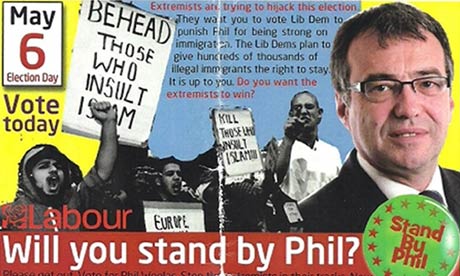
By Yvonne Ridley
http://www.tehrantimes.com/index_View.asp?code=229930
TERHRAN TIMES
So, former British Government minister Phil Woolas has finally been rumbled for playing the race and religion cards in a political game which has fuelled Islamaphobia in the UK.
Two high court judges have ordered that his election as MP for Oldham East and Saddleworth is “void”. Woolas was brought before the court on accusations of stirring up racial hatred and seizing on anti-Muslim sentiment in Oldham by claiming that his rival endorsed a Muslim campaign to remove him.
His campaign aimed to “make white folks angry” at his opponent, the Liberal Democrat’s Elwyn Watkins, as part of a desperate bid to retain his seat in the run up to the May 2010 general election. Whipping up hysteria and rhetoric that could make him a Tea Party candidate in America, Woolas is now barred from the House of Commons and ordered to pay £5,000 and costs to Mr. Watkins.
He says he will seek a judicial review but it’s not looking good -- as he stands there exposed for what he is, Labour has put a barge pole’s distance between themselves and the disgraced politician. The Westminster Village is said to be reeling in a state of shock… but why? I exposed the political scumbag way back on February 18 2008. Actually, my exact words to describe the government minister at the time were “an odious, rancid, little creep.”
This is what I wrote: “One of the biggest Islamophobes sitting in Government is Phil Woolas, who deserves further scrutiny in this column. He was the minister for race relations in the autumn of 2006 when he intervened in the row over the classroom assistant Aisha Azmi by calling for her to be fired. Aisha was the girl who work a nikab over her face whenever a male colleague entered the room, but by the time he and the media had finished you would have thought Aisha spent her entire teaching days in a full face veil. This is the MP who during the last General Election stamped the Union Jack emblem on his campaign literature and highlighted 'anti-white racism' as a vital issue in his Oldham constituency. His mates told him it was political suicide and that he would lose his marginal seat but in fact his votes increased and sent the anoraks in Labour’s spin machine into statistical overdrive. They realized then they didn’t need to try and win back the disaffected Muslims who ditched Labour over Iraq and Afghanistan. So instead of trying to bring them back into the fold, these cynical politicians opted instead to stir up racial tension as a means of appealing directly to the white working-class vote”.
The full column is here: http://yvonneridley.org/yvonne-ridley/articles/you -can-only-demand-to-be-treated-as-an-equal-if-you- act-like-one-5.html
The Woolas shock election victory after the disastrous Iraq war was achieved by using the race and religion card -- his politics of hate was a winning formula and Tony Blair’s backroom strategists loved it… once they’d recovered from the shock, for the truth is they had written off Woolas as a political casualty of the 2003 war since he was based in a marginal constituency with a large Muslim community.
The actions of Woolas triggered a new New Labour strategy which sought to encourage columns and online blogs written by aggressive secularists and so-called progressives to make Islam-bashing trendy. It was a poison which began creeping in to newspaper and magazine columns as well.
Those driven by racism also joined in the fun seeing Islamophobia as the last legitimate refuge to peddle their race-fueled hate. Phil Woolas was the man responsible for making Islamaphobia a national sport and while I'm sure he will be repulsed by the activities of the British National Party and the English Defense League they thrived in this atmosphere.
There were a few notable exceptions within the party including London Mayor Ken Livingstone who refused to enter in to political Muslim-baiting and at one point some sections of the media turned on him damaging his own political campaign in the English capital.
Meanwhile in the last General Election Labour ruthlessly deployed the politics of fascism to win popular votes and approval. Using the ‘Woolas’ model they placed the politics of religious identity at the centre of public debate, in the same opportunist way that Jorg Haider's Freedom Party did in Austria and Pim Fortuyn's List Party had previously done in Holland. Geert Wilders went on to take the hate to new levels. The fire of Islamaphobia rages across Europe today. Control orders, the use of secret evidence, tougher anti-terror laws -- all aimed at the Muslim communities -- came to define the Labour government's role in the ill-conceived War on Terror.
This incendiary atmosphere of growing Islamophobic intolerance continued to be ignited by the actions of the then Government minister on Race, Phil Woolas, who cynically drove the bandwagon through Muslim communities at every available opportunity.
He created hysterical headlines about ""Muslim inbreeding"" with his comments about the health risks of cousin marriages among Pakistanis. The way he spoke about the issue was as though some Frankenstein-like creatures were filling the baby wards in maternity hospitals around Oldham, Bradford, Burnley and Birmingham.
Tony Blair and Gordon Brown, both stirred the political pot of religion and racism, the latter wading in to Jack Straw’s nikab row with gusto. It seems every Labour minister was scrambling over the backs of others to attack Islam and Muslims.
Meanwhile, the enemies of Islam are still circling in politics and the media. They are trying to force Muslims to adopt an Islam which is servile to the West, a designer Islam that can be picked up and taken off like a pair of Jimmy Choos. What have they got to fear from Muslims in Britain who simply want to uphold family values which were once held so dear in British communities before binge drinking, promiscuity and pill-popping became so commonplace? There is no reason why Muslims can not contribute positively to Britain and elsewhere in the West without diluting their faith. It is not asked of other communities so why single Muslims out for special treatment?
The Commons Speaker, John Bercow will now have to decide whether to wait for further legal proceedings or immediately call a by-election for Oldham East and Saddleworth. The political power is now back with the people of that constituency -- good people of faith and no faith.
I would urge each and every one of them to vote, and vote for the politician who best suits their ideals… someone who is prepared to serve the people and not manipulate voters by trading on fear and hatred.
Hopefully the downfall of Woolas will serve as a salutary warning to all of those who indulged in the fascist politics of race, religion and fear.
Subscribe to:
Posts (Atom)