Showing posts with label snp. Show all posts

Tuesday, 24 April 2012

George Galloway predicts Scottish Labour's 'tubes and empty jaikets' will help SNP to independence victory


A savaging of Scottish Labour by Galloway. And praise for the SNP - who he has always expressed the most utter contempt for . Is George about to ditch a lifetimes loyalty to Labour and the Union? Ever the opportunist, he does have a keen sense for which way the wind is blowing and as a successful populist politician it helps to know what and when to embrace that which is popular and dump that which isnt... - The REAL Scottish Defence League.

George Galloway predicts Scottish Labour's 'tubes and empty jaikets' will help SNP to independence victory

Controversial politician George Galloway has predicted victory for Alex Salmond and the SNP in the independence referendum planned for autumn 2014.


Describing the current crop of Labour MSPs as ''tubes and empty jaikets'', the Respect MP said stopping the SNP's ''inch-by-inch'' campaign to break up the United Kingdom would be ''beyond them''.
george galloway
Mr Galloway, who was elected Bradford West MP in a stunning by-election victory last month, hailed the ''amazing transformation'' of the SNP under Mr Salmond, the First Minister.
He said the Nationalists have ''shamed'' Scottish Labour in recent years by taking ''principled positions'' similar to Labour's before Tony Blair took over as leader.
Mr Galloway repeated his personal opposition to independence, highlighting the similarities between a ''young person in Bradford and one in Barrhead''.
But he said the SNP are now in such a dominant position, securing a 'No' vote in the independence referendum looks like ''mission impossible''.
The assessment will worry the pro-Union camp, with many political commentators believing Labour will be key to convincing Scots to vote to remain in the UK.
Writing in Holyrood magazine, Mr Galloway noted that he had unsuccessfully stood for the Scottish Parliament in last year's election.
''If I'd gone to the Scottish Parliament I would have campaigned, of course, against this inch-by-inch to independence, which I've opposed all my political life,'' he said.
''Scottish people hate the Tories but they've largely given up on the hijacked Labour Party and I'm not sure they can ever be won back.''
After praising the changes made to the SNP by Mr Salmond, he added: ''I oppose the split because I don't believe there's a difference between a young person in Bradford and one in Barrhead, but the former will be poorer if it happens.''
Meanwhile, former First Minister Henry McLeish has backed Alex Salmond's plans for a second question on the independence referendum.
The ex-Fife Labour MSP handed a huge boost to the SNP leader by insisting there is an ''overwhelming case'' for the option of more devolution short of independence being put on the ballot paper.
Mr Salmond has said he is ''open'' to the possibility, but all the main unionist parties are against it.
Writing in a magazine this week, Mr McLeish said: ''There is an overwhelming case for a second question to give real choice to the Scottish people and if, as everyone says, the 'Yes' vote should be unambigious, then so too should be the meaning of the 'No' vote.''
Photo by Danny Lawson/PA Wire

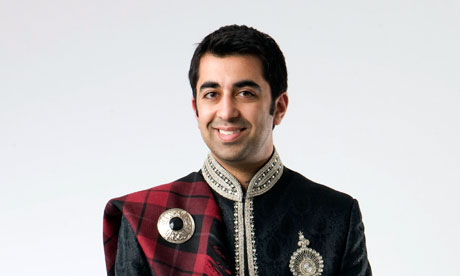
SNP's Humza Yousaf: 'You have to keep being radical with your ideas'


SNP's Humza Yousaf: 'You have to keep being radical with your ideas'

Humza Yousaf: 'People are just looking for that alternative.'How does an 'alternative' party that finds itself in power preserve its credentials?
On the wall of Humza Yousaf's office in central Glasgow there's a recent spread from the Scottish edition of the Sun. "I'm just as comfortable with a chapati in my hand as a bag of chips," says the characteristically subdued headline, leading into text that celebrates Yousaf as "the motorbike-riding, kilt-wearing nationalist who also cooks a mean curry", and gets in a lather about his "'united colours of Benetton' family home".
In England and Wales, talk about politics being in the midst of serious change is somewhat speculative, whereas in Scotland, it's a matter of hard fact. Alex Salmond and the SNP remain almost ludicrously dominant. Labour can feel borderline irrelevant, even in its traditional heartlands: the party has already lost its once-immovable majority on Glasgow city council, and come 3 May, there are serious predications that control will be won by the nationalists. The Tories are a negligible Scottish presence, and the fate of the Lib Dems was pointedly illustrated by last year's Inverclyde byelection, where they managed just 2% of the vote. There is, moreover, the looming referendum on independence. Compared with the reality of 10 years ago, everything has changed; and Yousaf himself is a reminder of huge shifts within Scottish nationalism itself – specifically, the way that it has slipped free of any identification with any particular section of Scottish society, and found itself able to speak to the whole country.
An MSP since last year, Yousaf – who is 27 – is an assured, articulate presence, tipped for great things. His father, who owns a successful Glasgow accountancy firm, joined the SNP in 1974, when one of his teachers at night school convinced him that the party was more worthy of his commitment than Labour. As with Salma Yaqoob, Yousaf's own political epiphany came in the wake of 9/11. Within weeks, having split off from a protest against the invasion of Afghanistan, he found himself in a human blockade of the nearby Charing Cross exit of the M8: "We had our two hours, freezing our arses off. And that was it: I was hooked."
He recalls 25 coaches going from Glasgow's Central Mosque to the huge London march against the Iraq war, and how Salmond's opposition to the invasion decisively pulled him towards the SNP – before dispensing his account of why Scotland has been so radically transformed. The story takes in Tony Blair's toxic effects on the reputation of the Labour party, the credit crunch and subsequent economic crash, and now the arrival of the Westminster coalition – all of which, he says, has fed into the SNP successfully turning old orthodoxies on their head. But even in England, he senses that the usual rules of politics are under threat.
"People are just looking for that alternative: there's no doubt about it. The Liberal Democrats, I think, would have been the ones who would have benefited from it, but they no longer can. As much as I really don't like George Galloway at times, I have to tip my hat to him when he says things like: 'If a backside had three cheeks, they'd be those parties.'"
He concedes that in its second term in power, the SNP has to guard its "alternative" credentials very carefully: "You have to keep being radical with your ideas. We're lucky: we have a completely distinct policy on independence, which helps us a lot." The next bit is put beautifully: "But there's always a danger of being one of one of those butt cheeks."
On this point, I wonder: though he gives me the usual assurances that his party is a pretty radical, left-of-centre force, aren't such claims at least slightly undermined by those SNP-ers whose views often seem to put them rather closer to free-market Tories? I've met a few. "We've now got 22,000 members," he says. "And not all of them are left of centre … not everybody sings from exactly the same hymn sheet. But generally there's a consensus in the party that we're comfortable with being a left-of- centre, social democratic party. To the left of Labour? The current Labour party, sure."
Not entirely surprisingly, he thinks the independence referendum will go the SNP's way. But I wonder: what does he think of the idea that if Scotland leaves the union, he and his SNP colleagues will effectively be leaving the English likes of me to eternal Tory government?
"No!" he shoots back, and sketches out one of the most interesting scenarios that might result from the Scots going it alone: an English realignment, whereby leftwing people south of the border might discover the courage of their convictions, whether inside the Labour party or out. "The prospect of an independent Scotland is a challenge for left progressives in England – to wake up, and start being more robust about what they believe in. And if anything, a strong left of centre, independent Scotland would be something to aspire to: 'If they can do it, why can't we?'"

Sunday, 11 March 2012

SNP outlines plans for 'Yes' campaign


Sun, 11/03/2012 - 12:37

The Scottish National Party (SNP) has outlined plans at its Spring Conference in Glasgow for a broad, massive ‘Yes’ campaign for the independence referendum involving sectoral groups across Scottish society.

Last weekend, Alex Salmond announced that the Yes campaign will be launched shortly after the local elections (3 May) and close of the Scottish Government's referendum consultation (11 May).

SNP Independence Referendum Campaign Director and Westminster Leader Angus Robertson MP told delegates that plans are already at an advanced stage for the launch.

He gave details of the organisation which will “bring together all supporters of independence" who want to help secure a historic ‘YES’ vote”.

Sectoral campaigns will bring together people with particular interests across Scottish society, including: Business for Independence, Trade Unionists for Independence, Women for Independence, Artists for Independence, Veterans for Independence, Youth for Independence, Senior Citizens for Independence, and many others.

Further plans were outlined for “the most effective campaign in Scottish political history”, including a cutting-edge website, the updated ‘Activate’ campaign data-management system and GPS campaign smart phone technology for effective campaigning.

The details were presented to SNP delegates after a run of more than 20 Independence Referendum Roadshow
events around the Scotland which have been attended by more than 2,000 people.

In his Independence Referendum presentation to the SNP Spring Conference Angus Robertson MP said:

“I am happy to confirm that we are working towards a ‘YES Campaign’launch shortly after the Local Government elections.

“There will be a dedicated campaign structure at national level, providing materials, coordinating activities, research and resources.

"There will be local campaigns directing grassroots activities, from district level to town and community level.

“And there will be sectoral campaigns bringing together people across Scottish society, including: Business for Independence, Trade Unionists for Independence, Woman for Independence, Artists for Independence, Veterans for
Independence, Youth for Independence, Senior Citizens for Independence and many others.

"We will use cutting edge IT and communication technology to run the most effective campaign in Scottish political history.

"All of these innovations are important, but they will not replace the most important element of all in this campaign, which is the involvement of record numbers of ordinary people around country.

“This will be a campaign for everyone. This is about our collective future and future generations. Together we will change Scotland for the better.”

Tuesday, 25 October 2011

The referendum no one is talking about

NEW STATESMAN

Scottish National Party Leader and Scotland's First Minister, Alex Salmond, addresses the SNP conference. Photograph: Getty Images.

Posted by George Eaton - 25 October 2011 15:43
While Westminster is fixated on the EU, Scotland is moving ever closer to independence.


While the Tories have been warring over whether to hold a national vote on EU membership, Alex Salmond has been quietly devising his strategy for a different referendum. As the SNP leader confirmed at his party's conference last weekend, the ballot paper will contain two questions. The first will be a straight yes/no question on Scottish independence, the second will be on full fiscal autonomy or "devolution max" (devo max).

Aware that he may not be able to win a majority for independence, Salmond is attempting to ensure that the SNP ends up with a consolation prize. But no one should underestimate how radical a step fiscal autonomy would be. Scotland would win complete control over spending, borrowing and taxation, leaving Westminster in charge of foreign affairs and defence. In an ingenious move, Salmond is attempting to turn the SNP into the party of independence and the party of devolution. The distance between the two is smaller than some imagine. An independent Scotland would retain the Queen as its head of state, British military bases (although the Trident subs would go) and the pound until, in Salmond's words, "it was in Scotland's economic advantage to join the euro" (in other words, indefinitely).

However, there is every reason to believe that Scotland will vote for full independence in the second half of the five-year Holyrood parliament. The SNP has already amassed a £1m campaign war chest and the polls are moving its way. A ComRes survey published on 15 October showed that 49 per cent of Scots now favour independence, with just 37 per cent opposed. Scottish Lib Dem leader Willie Rennie posed the question: "What if devo max got 99 per cent 'yes' and one per cent 'no' in the vote while the independence option got 51 per cent 'yes' and 49 per cent 'no'?" But Salmond has already confirmed that a slim majority for independence will trump a large majority for devo max. A brilliant politician and strategist, he will wait until discontent with the Westminster coalition is at its height before calling a referendum.

Labour and the Tories, leaderless as they are in Scotland, are not even close to devising a strategy to combat Salmond. After the SNP's remarkable victory in May, David Cameron vowed to defend the United Kingdom with "every fibre in my body". But we've seen little evidence of that so far. As for Ed Miliband, he has largely avoided the subject since forgetting the name of one his party's leadership candidates (Ken Macintosh), even though Scottish independence would automatically strip his party of 41 seats. For now, all the momentum is with Salmond and the SNP. This must change. And soon.

Sunday, 17 October 2010

Full independence will save Scotland from worst of cuts, says Alex Salmond

First minister says 'bad' cuts – expected to lead to a fall of about £4bn in Scottish budget – are attack on compassion, fairness and social justice

Severin Carrell Scotland correspondent guardian.co.uk,
Sunday 17 October 2010


http://www.guardian.co.uk/politics/2010/oct/17/alex-salmond-scotland-independence-cuts

Alex Salmond says independence would save Scotland's public services and economy from the worst effects of the spending cuts. Photograph: David Cheskin/PA


Alex Salmond today claimed full independence would save Scotland's public services and economy from the worst effects of the "bad" spending cuts due to be unveiled this week.

The first minister said Wednesday's comprehensive spending review – expected to lead to a fall of about £4bn in the Scottish budget – was an attack on the core principles of compassion, fairness and social justice dear to Scottish voters.

He told the Scottish National party's annual conference in Perth that he would "not be a manager of Westminster-directed cuts nor part of parliament which acts as a message boy for decisions made elsewhere".

In a speech that sought to be ambitious in its vision and scope before next May's Scottish elections, Salmond said: "There is no point in being a pocket money parliament when the pocket money stops.

"We are not the helpless agents of globalisation, but free citizens of a wealthy land. We are not slaves to the banking system or vassals to the lords of high finance.

"I do not want independence for its own sake, but for the sake of the people here and now and those to come."

The Scottish secretary, Michael Moore, has predicted that the cuts would take Scotland's funding back to its level in 2005 – about £25bn, a drop of some £4bn – by 2015.

The Scottish government claims that keeping all Scotland's share of North Sea oil and gas would leave it £1bn a year better off.

Salmond's ministers have begun setting out cuts in public services, including a 25% cut in NHS managers, but the first minister's main aim today was to rally his party for the 2011 Scottish parliamentary elections.

After nearly four years in power, the SNP faces a bruising contest. Early opinion polls suggest Labour is poised to regain power at Holyrood and form its own minority government.

Labour – now the only major party at Holyrood which is not in government – will attack the nationalists for breaking a series of pledges at the last Scottish elections, presiding over higher unemployment, NHS job cuts and a collapse in school building.

During the conference, the SNP has pledged to keep the freeze in council tax for a further two years, costing £70m a year.

Salmond announced that up to 6,000 government and NHS workers would get a "living wage" of at least £7.15 an hour – costing around £3m – and Scotland's seven police forces could be merged.

He did not specify a number, but it is thought ministers believe only three forces are needed.

He also announced that Joseph Stiglitz, the Nobel prize-winning economist who has been severely critical of George Osborne's spending plans, would now advise the SNP government on the economy.

Campbell Christie, a former head of the Scottish TUC, will lead a commission inquiry into public services. But Salmond has attempted to sidestep a policy by policy confrontation over spending cuts by accusing all his main opponents of preventing Scotland from achieving its full potential – full independence within the European union.

He acknowledged that the SNP had failed to make its case on independence by assuming voters knew what it meant, and reached out to Labour and left of centre Liberal Democrat voters.

"What I mean by independence is the profound right to enjoy the same equality of opportunity, and to live in more equal communities," he said. "What I mean by independence is jobs – to protect and create them.

"Is this a grand dream? Yes. But that is the difference between us and the other parties in this election.

"We have the vision and we have the means to deliver it ... [I] fight not for flags and anthems, but fairness and compassion. I fight for a generation that is not burdened by the mistakes of this one."

The three main UK parties killed off his bill for a referendum on independence in this parliament and only about 25% of voters currently favour independence.

But the SNP believes the spending cuts will significantly bolster its arguments for autonomy, and plans to make that dispute central to its election campaign.

Iain Gray, the Scottish Labour leader, said: "Alex Salmond is the last man Scotland should listen to on jobs and cuts. [Due] to the Salmond slump, we have lost 50,000 construction jobs and the SNP have also cut 3,000 teachers and 4,000 NHS jobs – all this with a record Scottish budget.

"Now is a time for honesty, tough decisions and protecting and creating jobs. However, Alex Salmond thinks he can get by on election gimmicks, dodge all responsibility and blame someone else for his legacy of failure."

Saturday, 9 October 2010

Scottish Republicanism and what it means today

(This article was origianlly published in the Arpil-May, 2010 edition of Sovereign Nation, the newspaper of the 32 Country Soverignty Movement)


For over 300 years the nation of Scotland has been shackled
to the political union of unequals that is the British
state. For centuries prior to this forced union Scotland
fought a gallant series of wars of independence against
English attempts at subjugation and annexation. That her
Sovereignty was betrayed by the parcel of rogues in a
nation which were a supine section of the Scottish landed
nobility cannot be disputed, but the British revisionist
historians who claim that this union was popular in anyway
shape or form couldn't be more wrong.

Riots broke out against the signing of the Act of
union the length and breadth of Scotland, indeed the very signatories
to the union had to meet in secret in a cellar in
Edinburgh - such was their fear of the Scottish peoples reaction.

England achieved its union by bribery and coercion
("the rough wooing" as it was called). The signing of the treaty
was conducted with an English Fleet off the Scottish coast and
an English Army massed at the border - the threat to Scotland
should the traitors not sign the Act of Union could not have
been more explicit.

Like all subjugated peoples the Scottish have had
imposed upon them an official history of the victors that has
sought to obscure any understanding of resistance and rebellion
and that has sought to give them a historical amnesia that
prevents them from challenging the myths of the British state.
Religious sectarianism and all manner of divide and rule has
been used by the Anglo/British state and its mis-educators to
weaken and avoid a united Scottish challenge to their rule.

In such a way the Jacobite Rebellions have been
portrayed as doomed romanticism on behalf of a foppish and
effete King when in fact they had as their foundation a sincere
desire on behalf of their clansmen and others for Scottish
independence. Many a Jacobite sword had inscribed on its
blade for Scotland and no union, in English and in Gaelic.

Even more denied and obscured by the Brits and
their academic mouthpieces is the later struggle of Thomas
Muir, a radical Scottish republican and contemporary of Wolfe
Tone, who led the United Scotsmen and had excellent fraternal
relations and practical solidarity with the United Irishmen.
Just as Wolfe Tone can be said to be the Father of Irish
Republicanism so too can Muir be called the Father of
Scottish Republicanism. The British and their lackeys in the
Scottish establishment worked ceaselessly through lies, force and spies to defeat the plans of the United Scotsmen for revolution
and the re-establishment of Scottish independence
and a Republic in the late 1790s. Muir himself had to flee to
France where he became the first non Frenchman given citizenship
in the French Republic.

The Scottish Radicals of 1820 attempted armed
rebellion and a detachment were captured on route to Carron
where they hoped to seize the cannons of the Brits at the
major cannon producing ironworks there. Hardie and Baird
died on the scaffold and the rest of the leaders were rounded
up and deported to Australia as convicts. In Greenock the
British militia opened fire on the crowd, killing many unarmed
civilians, who had risen in support of the rebellion.

In the Highlands and Gaeltacht resistance broke out sporadically
against the near genocide of the clearances and the latter
parts of the 19th century saw land grabs and the simmering
Crofters War. Michael Davitt was instrumental in helping
organise the Highland Land League. By the late 19th Century
following An Gorta Mor, Scotland saw an influx of Irishmen
and women as a direct result of the genocidal policies of the
Anglo/British state. Combining with the hundreds of thousands
of cleared from their land, Gaels of the Highlands who
had been forced into the urban industrial central belt, particularly
around Glasgow, fired an angry working class with rightful
grievance and a sense of injustice against the British state
and its ruling class. Thus they emerged with an innate dslike,
distrust and hatred for the Anglo/British state and a strong
desire for Irish and indeed Scottish independence. Out of this
working class came two of the greatest Republican socialists.
In Edinburgh was James Connolly and in Glasgow John
MacLean. They took the fight for independence and the
republic of the workers to a new plane of struggle.

Whilst Connolly was organising Irish workers and small farmers
for revolution in Ireland, MacLean was developing the
forces for revolution in Glasgow and on Clydeside. MacLean
broke with the British left due to their supine acceptance of the
imperialist slaughter of WW1 and came out for a Scottish
Workers Republic. In 1919 English soldiers and tanks were
placed in Glasgow in order to quell the growing rebellion that
was known as the Red Clydeside. He himself was jailed for sedition on a number of occasions and his popularity amongst the workers of Glasgow and Scotland can be
gauged by the 200,000 who came out to meet him from the train on his release from Peterhead Gaol.

Despite the best efforts of the unionist Labour quislings
in Scotland and their masters in London, the question of
independence runs throughout modern Scottish history. It
truly is the elephant in the room on all political matters in
Scotland. Recently the twin tectonic plates of independence
and unionism have collided and the attempt by the Brits to
"kill independence stone dead through devolution" has done
nothing of the sort. In fact devolution has merely whetted the
appetite for independence in Scotland and the one party state
hegemony of the unionist Labour Party, which stretches over
50 years, has been broken with the election in 2007 of the
first Scottish National Party Government. As republicans we
can confidently say that the SNP whilst being a constitutional
nationalist party, has at its base thousands of republican separatist
members and supporters and indeed even amongst its
elected representatives a good few solid republicans and
republican socialists. Salmond himself was once a member
of the expelled republican socialist 79 Group.

From our perspective and given the political terrain
and conditions the SNP is the credible democratic electoral
challenge to unionism and the British state. Whilst we maintain
a revolutionary republican perspective towards independence
we should urge all Scots and Irish Republicans living
in Scotland to support the SNP in elections and campaign
and vote in any upcoming referendum put forward by the
SNP for full Scottish independence.

The anti colonial and anti imperialism of the struggle
for Irish independence and Scottish independence and
the fact that both struggles and nations have so much commonality
against English dominion mean that the 32 CSM in
Scotland and our Vol Charles Carrigan Cumann have not
neglected to fully engage in the struggle for Scottish independence
alongside our support and solidarity for our comrades
and their struggle for Irish sovereignty, independence
and the 32 County Republic.

The 32CSM have worked alongside and supported
efforts by the Scottish Republican Socialist Movement including
attending the John MacLean March and Rally in Glasgow
and the Anti Sectarianism march and rally at Glencoe. We will
continue this work for a Scottish Republic which we believe
could be the closest ally for the 32 County Irish Republic.
Whichever nation first gains a victory against Anglo/British
imperialism and their continued denial of our national sovereignties
will have a profound effect on the struggle in the
other. Not least because of the crisis it will create in the false
identity of British unionism that exists in both Ireland and
Scotland.