Showing posts with label scotland. Show all posts

Tuesday, 24 April 2012

SNP's Humza Yousaf: 'You have to keep being radical with your ideas'
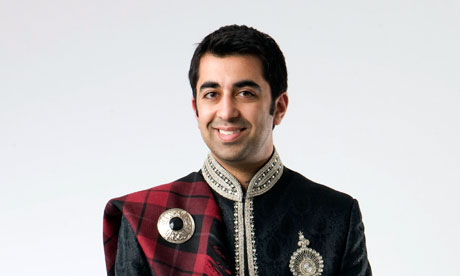

SNP's Humza Yousaf: 'You have to keep being radical with your ideas'

Humza Yousaf: 'People are just looking for that alternative.'How does an 'alternative' party that finds itself in power preserve its credentials?
On the wall of Humza Yousaf's office in central Glasgow there's a recent spread from the Scottish edition of the Sun. "I'm just as comfortable with a chapati in my hand as a bag of chips," says the characteristically subdued headline, leading into text that celebrates Yousaf as "the motorbike-riding, kilt-wearing nationalist who also cooks a mean curry", and gets in a lather about his "'united colours of Benetton' family home".
In England and Wales, talk about politics being in the midst of serious change is somewhat speculative, whereas in Scotland, it's a matter of hard fact. Alex Salmond and the SNP remain almost ludicrously dominant. Labour can feel borderline irrelevant, even in its traditional heartlands: the party has already lost its once-immovable majority on Glasgow city council, and come 3 May, there are serious predications that control will be won by the nationalists. The Tories are a negligible Scottish presence, and the fate of the Lib Dems was pointedly illustrated by last year's Inverclyde byelection, where they managed just 2% of the vote. There is, moreover, the looming referendum on independence. Compared with the reality of 10 years ago, everything has changed; and Yousaf himself is a reminder of huge shifts within Scottish nationalism itself – specifically, the way that it has slipped free of any identification with any particular section of Scottish society, and found itself able to speak to the whole country.
An MSP since last year, Yousaf – who is 27 – is an assured, articulate presence, tipped for great things. His father, who owns a successful Glasgow accountancy firm, joined the SNP in 1974, when one of his teachers at night school convinced him that the party was more worthy of his commitment than Labour. As with Salma Yaqoob, Yousaf's own political epiphany came in the wake of 9/11. Within weeks, having split off from a protest against the invasion of Afghanistan, he found himself in a human blockade of the nearby Charing Cross exit of the M8: "We had our two hours, freezing our arses off. And that was it: I was hooked."
He recalls 25 coaches going from Glasgow's Central Mosque to the huge London march against the Iraq war, and how Salmond's opposition to the invasion decisively pulled him towards the SNP – before dispensing his account of why Scotland has been so radically transformed. The story takes in Tony Blair's toxic effects on the reputation of the Labour party, the credit crunch and subsequent economic crash, and now the arrival of the Westminster coalition – all of which, he says, has fed into the SNP successfully turning old orthodoxies on their head. But even in England, he senses that the usual rules of politics are under threat.
"People are just looking for that alternative: there's no doubt about it. The Liberal Democrats, I think, would have been the ones who would have benefited from it, but they no longer can. As much as I really don't like George Galloway at times, I have to tip my hat to him when he says things like: 'If a backside had three cheeks, they'd be those parties.'"
He concedes that in its second term in power, the SNP has to guard its "alternative" credentials very carefully: "You have to keep being radical with your ideas. We're lucky: we have a completely distinct policy on independence, which helps us a lot." The next bit is put beautifully: "But there's always a danger of being one of one of those butt cheeks."
On this point, I wonder: though he gives me the usual assurances that his party is a pretty radical, left-of-centre force, aren't such claims at least slightly undermined by those SNP-ers whose views often seem to put them rather closer to free-market Tories? I've met a few. "We've now got 22,000 members," he says. "And not all of them are left of centre … not everybody sings from exactly the same hymn sheet. But generally there's a consensus in the party that we're comfortable with being a left-of- centre, social democratic party. To the left of Labour? The current Labour party, sure."
Not entirely surprisingly, he thinks the independence referendum will go the SNP's way. But I wonder: what does he think of the idea that if Scotland leaves the union, he and his SNP colleagues will effectively be leaving the English likes of me to eternal Tory government?
"No!" he shoots back, and sketches out one of the most interesting scenarios that might result from the Scots going it alone: an English realignment, whereby leftwing people south of the border might discover the courage of their convictions, whether inside the Labour party or out. "The prospect of an independent Scotland is a challenge for left progressives in England – to wake up, and start being more robust about what they believe in. And if anything, a strong left of centre, independent Scotland would be something to aspire to: 'If they can do it, why can't we?'"

Tuesday, 17 April 2012

PROUD TO BE A MONGREL NATION: Study reveals 'extraordinary' DNA of people in Scotland


Study reveals 'extraordinary' DNA of people in Scotland

Tom ContiThe study revealed that actor Tom Conti is related to Napoleon Bonaparte
SOURCE

The DNA of people living in Scotland has "extraordinary" and "unexpected" diversity, according to a new study.


The Scotland's DNA project, led by Edinburgh University's Dr Jim Wilson, has tested almost 1,000 Scots in the last four months to determine the genetic roots of people in the country.
The project discovered four new male lineages, which account for one in 10 Scottish men.
It also found that actor Tom Conti is related to Napoleon Bonaparte.
Scotland's DNA was set up by Dr Wilson along with historian Alistair Moffat, the current rector of St Andrews University.
Using new technology, scientists were able to pinpoint a participant's DNA marker, from which they tracked the person's history and lineage.
Conti and Napoleon both share the M34 marker, which is Saracen in origin.
The project found that Scotland has almost 100 different groups of male ancestry from across Europe and further afield.
More than 150 different types of female DNA from Europe, Asia and Africa were discovered.
Royal line
Researchers believe that Scotland's location could be a factor in the "astonishing and unique" origins of people from the country.
In a statement, Dr Wilson and Mr Moffat said: "Perhaps geography, Scotland's place at the farthest north-western end of the European peninsula, is the reason for great diversity.
"For many thousands of years, migrants could move no further west. Scotland was the end of many journeys."
Scotland's DNA also found that more than 1% of all Scotsmen are direct descendants of the Berber and Tuareg tribesmen of the Sahara, a lineage which is around 5600 years old.
Royal Stewart DNA was confirmed in 15% of male participants with the Stewart surname. They are directly descended from the royal line of kings.
Scientists believe comedian and presenter Fred MacAuley's ancestors were slaves, sold at the great slave market in Dublin in the 9th Century, despite his name suggesting a Viking heritage.
They said MacAuley's slave ancestor was taken by ship to the Hebrides and had an affair with his owner's wife, thereby intruding DNA into the MacAulay line.
Scotland's DNA will soon be renamed Britain's DNA as the project aims to widen its genetic study to include the English, Welsh and Irish.

Saturday, 14 April 2012

MORE VICTORIES AGAINST POLICE OPPRESSION FOR GLASGOW ACTIVISTS


MORE VICTORIES AGAINST POLICE OPPRESSION FOR GLASGOW ACTIVISTS
‘The law is simply and solely made for the exploitation of those who do not understand it or of those who, for naked need, cannot obey it.’ Bertolt Brecht
The last two months have again seen significant victories in Glasgow in the fight against police repression, vindicating the relentless political campaigning led by Fight Racism! Fight Imperialism! members and the Glasgow Defence Campaign.
After a full year of protests and court pickets, on 12 December 2011 FRFI supporter Joey Simons was finally acquitted on all five charges issued against him following his arrest on a demonstration against student fees on 9 December 2010. Supporters packed the District Court over the four days of the trial as the shameless lies of five Strathclyde police officers were systematically exposed. The defence’s case was political throughout, underlining the consistent record of police harassment in the lead-up to the arrest.
Speaking outside the court, a GDC representative stated that the victory was ‘a significant setback for the attempts to criminalise political protest being led by the Crown Office and Strathclyde police. Throughout the past year we have stood firm inside and outside these court rooms in order to assert the right to protest and organise in the face of the cuts and attacks on the working class. The criminals in this case are all those officers who chose to perjure themselves – and yet none will face consequences for doing so. We would ask what type of justice system is this when such abuses of law go unpunished?’
The following day, the case against four activists from Unity – a group in solidarity with asylum seekers – was suddenly dropped by the Procurator Fiscal on their arrival at the Sheriff Court. The activists had been arrested after blockading the gates of the UK Border Agency reporting centre in Glasgow during a protest over the dawn raid and detention of single mother, Funke, and her five-year-old son Joseph. This was another important victory.
The most significant development involves the ongoing trial of another FRFI member, Dominic O’Hara, relating to his arrest in January 2010 at an anti-cuts demo. For the first time in Scotland, the use of kettling tactics by police is being challenged and a legal debate will take place on 1 March after Dominic’s defence asserted that his human rights had been breached on the day of his arrest. The Association of Chief Police Officers in Scotland will be forced out of the shadows to justify its aggressive tactics.
The importance of waging a political defence is clear: between August 2010 and April 2011, 14 charges were issued against members of FRFI in Glasgow. So far, 12 of these have been fought and won, the single guilty verdict resulted in no sentence and the final charge has now embroiled the Crown Office and Strathclyde police in a major legal challenge.
No to political policing!
Joey Simons
‘Despite these verdicts, today is not a cause for celebration...How can I celebrate when I know that this day could have come 18 years ago if the police who were meant to find my son’s killers had not failed so miserably to do so...The fact is that racism and racist attacks are still happening in this country and the police should not use my son’s name to say that we can move on.’ Doreen Lawrence
On 3 January 2012, two white men were convicted of the murder of black teenager Stephen Lawrence in southeast London nearly 19 years ago. The convictions of Gary Dobson and David Norris are, however, only a partial victory for all those, most notably Stephen’s parents, Doreen and Neville Lawrence, who campaigned so long for justice for their son. In doing so, they exposed entrenched police racism, culminating in the McPherson Report of 1999. Given the complete shambles of the original police investigation, marred from the very start by racist prejudice, corruption and sheer incompetence, it is extraordinary that there have been any convictions at all; the jailing of two of Stephen’s killers was made possible only by forensic advances since 1993 which allowed microscopic samples of blood, hair and fibres to link the two men to the scene of the crime and a 2003 change to the law that allowed Dobson, in the light of this new ‘compelling’ evidence, to be prosecuted again, having been cleared of the murder in 1996.
Racism and incompetence
But there is little cause for celebration. At least three other men involved in Stephen’s murder – James and Neil Acourt and Luke Knight, whose vicious racist fantasies were revealed on undercover video in 1994 – still walk free. That travesty is a direct result of the original, botched police investigation. From the moment police left Stephen lying in a pool of blood at an Eltham bus stop without attempting resuscitation – they were too busy asking his traumatised friend Duwayne Brooks if he and Stephen had provoked the attack – they had little interest in finding the suspects. Within 48 hours, nine different sources, including two police informants, had named five white suspects, a local gang of well-known racists with a record of violence. Four had been seen the night of the murder washing blood off themselves. A surveillance team failed to record the removal of bags potentially containing evidence from the suspects’ homes. Meanwhile, the police treated the Lawrence family as if it was they who were under suspicion. No arrests were made for two weeks until the Lawrences met Nelson Mandela on 6 May and he stated that, as in apartheid South Africa, ‘black lives are cheap’. By then it was too late. By July, the CPS had decided that there was not enough evidence to charge any of the men. An internal police inquiry in December 1993 concluded that the ‘investigation has been progressed satisfactorily and all lines of inquiry correctly pursued’.
But the campaign for justice, led by Stephen’s parents, had tremendous resonance, and over the years anger was growing that no-one had been convicted. At the inquest into his death in 1997 jurors took the unusual step of concluding that the black teenager was unlawfully killed ‘in a completely unprovoked racist attack by five white youths’. That verdict emboldened the Daily Mail, of all papers, to publish the following day its iconic ‘Murderers!’ front page, naming the five suspects with the challenge: ‘If we are wrong, let them sue us’. Within months, the McPherson Inquiry into the failures surrounding the investigation into Stephen’s death was set up. At its first sessions in Elephant & Castle, south London in 1998, Doreen Lawrence stated that ‘no black person should ever trust the police’ – a point borne out when the Met used CS spray against the massive crowd of mainly black people who had thronged to the hearing. Over a year of investigation that included travelling around the country to ask people about their experience of the police, the Inquiry team concluded not only that the original police investigation had been deeply flawed, but that the police, as well as other areas such as housing and education, were deeply riven by ‘institutional racism’. The Inquiry made 70 recommendations for change.
But nothing changed
Nearly 13 years on, following the Dobson and Norris convictions, the police and government commented smugly that ‘institutional racism’ had been rooted out. But the anger that exploded on the streets of England in August 2011 gives the lie to their complacency. Young people cited police harassment and racism, and particularly the use of stop-and-search, as the main fuse for their frustration. In 1999-2000, a black person was five times more likely to be stopped than a white person; now the figure is seven times, and black people are four times more likely to have their DNA stored on the police database. Alongside this has gone a massive stepping up of harassment of Asian communities since 2001, under the guise of ‘fighting terrorism’. 300 black people have died in police custody since 2000 – no police officer has ever faced any charges for these deaths. Around 96 racist murders have taken place since that of Stephen Lawrence; in at least 15 unsolved cases, family and friends blame police racism and indifference. These include the cases of Surjit Singh Chhokkar, stabbed to death in Scotland in 1998; Kamal Raza Butt, racially abused and called ‘Taliban’ before being beaten to death by a gang of youths in July 2005, and Lahkvinder ‘Ricky’ Reel, whose body was found in the Thames after he was racially abused in 1997.
The legacy of the Stephen Lawrence case must be, not McPherson’s well-meaning findings, but the lesson of Stephen Lawrence’s family that the only way to oppose and expose police racism is to organise, to fight back and to never give up.
Cat Wiener
See also: ‘Stephen Lawrence Inquiry: police racism exposed’, FRFI 143, June/July 1998;
‘The murder of Stephen Lawrence: a stinking shambles of police racism and corruption’, FRFI 144 August/September 1998
‘Ten years after McPherson: British police racist as ever and with more power’, FRFI 208, April/May 2009.

Friday, 16 March 2012

Tory peer's bizarre claim that Westminster would "bomb Scottish airports"

http://newsnetscotland.com/index.php/scottish-news/4559-tory-peers-bizarre-claim-that-westminster-would-qbomb-scottish-airportsq


THURSDAY, 15 MARCH 2012 16:21 41 COMMENTS
By a Newsnet reporter

Scots have become used to outrageous claims from Unionist politicians about the terrible things that would happen if Scotland voted to become independent. This week Conservative peer Peter Fraser, Lord Fraser of Carmyllie, has made possibly the most astonishing outburst of all. According to Mr Fraser, the Westminster government could bomb Glasgow and Edinburgh airports to defend itself from possible attacks if Scotland became an independent nation.

Mr Fraser insisted that if the Scottish people voted in favour of Scottish independence, the country would be left undefended. He expressed his fear that enemies of the rump-UK would then be able to use Scotland as a base for launching air strikes, adding: "If that were to happen what alternative would England have but to come and bomb the hell out of Glasgow airport and Edinburgh airport."

The former Solicitor General for Scotland and Lord Advocate also claimed that the SNP's desire to remove UK nuclear forces from Scotland and to reduce the country's navy to "fishery protection vessels" would turn Scotland into a warzone. A country with a few vessels for fishery guard was "asking to be invaded," he said.

He added: "I would not wish my beloved Scotland to be a war zone for those with evil intent on the sovereignty of England. That was, however, the risk. If we totally failed to defend ourselves alone or in conjunction with England, we offered up ourselves as the battleground."

The former Lord Advocate said he did not know who could have "evil intentions against England" but claimed that the twentieth century taught the world that never "let your guard down."

Mr Fraser's outburst comes in a week when SNP defence spokesperson Angus Robertson has highlighted the lack of UK defence cover in Scotland due to cuts in the MoD budget. The cuts leave Scotland without any long distance surveillance capacity, and with just two Royal Navy vessels other than those devoted to the protection of the UK's nuclear capacity based at Faslane on the Clyde.

However at the same time as he made his comments about Scottish airports being bombed, the Tory peer said that nothing will stop Scotland from becoming an independent nation and questioned whether fighting to keep the Union together is worth the effort.

Mr Fraser, a former minister in John Major's government, made the remarks on Monday during the launch of a pamphlet he wrote for the think-tank Politeia. In the pamphlet he writes: "All empirical evidence points to a break-up", and criticised Unionist politicians for their lack of "fresh thinking", adding that "the status quo points only to disaster" and claiming "there is a muddle over why the union matters."

Mr Fraser has a problematic history with Scottish airports. In February 2007 police were called to Dundee airport following reports of a disturbance on board an aircraft. Police arrested Mr Fraser, who was charged with disorderly conduct on an aircraft which had just landed at the airport. Later that month the Crown Office announced that it had dropped charges due to insufficient evidence.

Tuesday, 13 March 2012

Top tory claims England "Would bomb independent Scotland's Airports"

Herald, 13 March 2012

GLASGOW and Edinburgh airports, in an independent Scotland, could be bombed by an English government if it was threatened by an unfriendly country, a former deputy leader of the UK Conservative Party has warned.

Lord Fraser of Carmyllie also warned that SNP policies removing nuclear forces from Scottish bases and reducing Scotland's navy "essentially" to fishery protection vessels could make Scotland a war zone. He said a country with a few fishery protection vessels was "asking to be invaded".

The former Lord Advocate and Solicitor General said he did not see who might have "evil intentions" against England but he had missed "the import of the Balkan crisis and the ramifications of 9/11" and would hesitate "to predict the crises even in the rest of the century".

He foresaw the possibility of an enemy commander ordering the runways at Scottish airports to be cleared because his planes would be landing and "if that were to happen what alternative would England have but to come and bomb the hell out of Glasgow airport and Edinburgh airport".

He suggested one solution would be to base the nuclear fleet, currently based on the Clyde, to Scapa Flow in the Orkney Islands.

Sunday, 11 March 2012

SNP outlines plans for 'Yes' campaign


Sun, 11/03/2012 - 12:37

The Scottish National Party (SNP) has outlined plans at its Spring Conference in Glasgow for a broad, massive ‘Yes’ campaign for the independence referendum involving sectoral groups across Scottish society.

Last weekend, Alex Salmond announced that the Yes campaign will be launched shortly after the local elections (3 May) and close of the Scottish Government's referendum consultation (11 May).

SNP Independence Referendum Campaign Director and Westminster Leader Angus Robertson MP told delegates that plans are already at an advanced stage for the launch.

He gave details of the organisation which will “bring together all supporters of independence" who want to help secure a historic ‘YES’ vote”.

Sectoral campaigns will bring together people with particular interests across Scottish society, including: Business for Independence, Trade Unionists for Independence, Women for Independence, Artists for Independence, Veterans for Independence, Youth for Independence, Senior Citizens for Independence, and many others.

Further plans were outlined for “the most effective campaign in Scottish political history”, including a cutting-edge website, the updated ‘Activate’ campaign data-management system and GPS campaign smart phone technology for effective campaigning.

The details were presented to SNP delegates after a run of more than 20 Independence Referendum Roadshow
events around the Scotland which have been attended by more than 2,000 people.

In his Independence Referendum presentation to the SNP Spring Conference Angus Robertson MP said:

“I am happy to confirm that we are working towards a ‘YES Campaign’launch shortly after the Local Government elections.

“There will be a dedicated campaign structure at national level, providing materials, coordinating activities, research and resources.

"There will be local campaigns directing grassroots activities, from district level to town and community level.

“And there will be sectoral campaigns bringing together people across Scottish society, including: Business for Independence, Trade Unionists for Independence, Woman for Independence, Artists for Independence, Veterans for
Independence, Youth for Independence, Senior Citizens for Independence and many others.

"We will use cutting edge IT and communication technology to run the most effective campaign in Scottish political history.

"All of these innovations are important, but they will not replace the most important element of all in this campaign, which is the involvement of record numbers of ordinary people around country.

“This will be a campaign for everyone. This is about our collective future and future generations. Together we will change Scotland for the better.”

Tuesday, 25 October 2011

The referendum no one is talking about

NEW STATESMAN

Scottish National Party Leader and Scotland's First Minister, Alex Salmond, addresses the SNP conference. Photograph: Getty Images.

Posted by George Eaton - 25 October 2011 15:43
While Westminster is fixated on the EU, Scotland is moving ever closer to independence.


While the Tories have been warring over whether to hold a national vote on EU membership, Alex Salmond has been quietly devising his strategy for a different referendum. As the SNP leader confirmed at his party's conference last weekend, the ballot paper will contain two questions. The first will be a straight yes/no question on Scottish independence, the second will be on full fiscal autonomy or "devolution max" (devo max).

Aware that he may not be able to win a majority for independence, Salmond is attempting to ensure that the SNP ends up with a consolation prize. But no one should underestimate how radical a step fiscal autonomy would be. Scotland would win complete control over spending, borrowing and taxation, leaving Westminster in charge of foreign affairs and defence. In an ingenious move, Salmond is attempting to turn the SNP into the party of independence and the party of devolution. The distance between the two is smaller than some imagine. An independent Scotland would retain the Queen as its head of state, British military bases (although the Trident subs would go) and the pound until, in Salmond's words, "it was in Scotland's economic advantage to join the euro" (in other words, indefinitely).

However, there is every reason to believe that Scotland will vote for full independence in the second half of the five-year Holyrood parliament. The SNP has already amassed a £1m campaign war chest and the polls are moving its way. A ComRes survey published on 15 October showed that 49 per cent of Scots now favour independence, with just 37 per cent opposed. Scottish Lib Dem leader Willie Rennie posed the question: "What if devo max got 99 per cent 'yes' and one per cent 'no' in the vote while the independence option got 51 per cent 'yes' and 49 per cent 'no'?" But Salmond has already confirmed that a slim majority for independence will trump a large majority for devo max. A brilliant politician and strategist, he will wait until discontent with the Westminster coalition is at its height before calling a referendum.

Labour and the Tories, leaderless as they are in Scotland, are not even close to devising a strategy to combat Salmond. After the SNP's remarkable victory in May, David Cameron vowed to defend the United Kingdom with "every fibre in my body". But we've seen little evidence of that so far. As for Ed Miliband, he has largely avoided the subject since forgetting the name of one his party's leadership candidates (Ken Macintosh), even though Scottish independence would automatically strip his party of 41 seats. For now, all the momentum is with Salmond and the SNP. This must change. And soon.

Saturday, 9 October 2010

Scottish Republicanism and what it means today

(This article was origianlly published in the Arpil-May, 2010 edition of Sovereign Nation, the newspaper of the 32 Country Soverignty Movement)


For over 300 years the nation of Scotland has been shackled
to the political union of unequals that is the British
state. For centuries prior to this forced union Scotland
fought a gallant series of wars of independence against
English attempts at subjugation and annexation. That her
Sovereignty was betrayed by the parcel of rogues in a
nation which were a supine section of the Scottish landed
nobility cannot be disputed, but the British revisionist
historians who claim that this union was popular in anyway
shape or form couldn't be more wrong.

Riots broke out against the signing of the Act of
union the length and breadth of Scotland, indeed the very signatories
to the union had to meet in secret in a cellar in
Edinburgh - such was their fear of the Scottish peoples reaction.

England achieved its union by bribery and coercion
("the rough wooing" as it was called). The signing of the treaty
was conducted with an English Fleet off the Scottish coast and
an English Army massed at the border - the threat to Scotland
should the traitors not sign the Act of Union could not have
been more explicit.

Like all subjugated peoples the Scottish have had
imposed upon them an official history of the victors that has
sought to obscure any understanding of resistance and rebellion
and that has sought to give them a historical amnesia that
prevents them from challenging the myths of the British state.
Religious sectarianism and all manner of divide and rule has
been used by the Anglo/British state and its mis-educators to
weaken and avoid a united Scottish challenge to their rule.

In such a way the Jacobite Rebellions have been
portrayed as doomed romanticism on behalf of a foppish and
effete King when in fact they had as their foundation a sincere
desire on behalf of their clansmen and others for Scottish
independence. Many a Jacobite sword had inscribed on its
blade for Scotland and no union, in English and in Gaelic.

Even more denied and obscured by the Brits and
their academic mouthpieces is the later struggle of Thomas
Muir, a radical Scottish republican and contemporary of Wolfe
Tone, who led the United Scotsmen and had excellent fraternal
relations and practical solidarity with the United Irishmen.
Just as Wolfe Tone can be said to be the Father of Irish
Republicanism so too can Muir be called the Father of
Scottish Republicanism. The British and their lackeys in the
Scottish establishment worked ceaselessly through lies, force and spies to defeat the plans of the United Scotsmen for revolution
and the re-establishment of Scottish independence
and a Republic in the late 1790s. Muir himself had to flee to
France where he became the first non Frenchman given citizenship
in the French Republic.

The Scottish Radicals of 1820 attempted armed
rebellion and a detachment were captured on route to Carron
where they hoped to seize the cannons of the Brits at the
major cannon producing ironworks there. Hardie and Baird
died on the scaffold and the rest of the leaders were rounded
up and deported to Australia as convicts. In Greenock the
British militia opened fire on the crowd, killing many unarmed
civilians, who had risen in support of the rebellion.

In the Highlands and Gaeltacht resistance broke out sporadically
against the near genocide of the clearances and the latter
parts of the 19th century saw land grabs and the simmering
Crofters War. Michael Davitt was instrumental in helping
organise the Highland Land League. By the late 19th Century
following An Gorta Mor, Scotland saw an influx of Irishmen
and women as a direct result of the genocidal policies of the
Anglo/British state. Combining with the hundreds of thousands
of cleared from their land, Gaels of the Highlands who
had been forced into the urban industrial central belt, particularly
around Glasgow, fired an angry working class with rightful
grievance and a sense of injustice against the British state
and its ruling class. Thus they emerged with an innate dslike,
distrust and hatred for the Anglo/British state and a strong
desire for Irish and indeed Scottish independence. Out of this
working class came two of the greatest Republican socialists.
In Edinburgh was James Connolly and in Glasgow John
MacLean. They took the fight for independence and the
republic of the workers to a new plane of struggle.

Whilst Connolly was organising Irish workers and small farmers
for revolution in Ireland, MacLean was developing the
forces for revolution in Glasgow and on Clydeside. MacLean
broke with the British left due to their supine acceptance of the
imperialist slaughter of WW1 and came out for a Scottish
Workers Republic. In 1919 English soldiers and tanks were
placed in Glasgow in order to quell the growing rebellion that
was known as the Red Clydeside. He himself was jailed for sedition on a number of occasions and his popularity amongst the workers of Glasgow and Scotland can be
gauged by the 200,000 who came out to meet him from the train on his release from Peterhead Gaol.

Despite the best efforts of the unionist Labour quislings
in Scotland and their masters in London, the question of
independence runs throughout modern Scottish history. It
truly is the elephant in the room on all political matters in
Scotland. Recently the twin tectonic plates of independence
and unionism have collided and the attempt by the Brits to
"kill independence stone dead through devolution" has done
nothing of the sort. In fact devolution has merely whetted the
appetite for independence in Scotland and the one party state
hegemony of the unionist Labour Party, which stretches over
50 years, has been broken with the election in 2007 of the
first Scottish National Party Government. As republicans we
can confidently say that the SNP whilst being a constitutional
nationalist party, has at its base thousands of republican separatist
members and supporters and indeed even amongst its
elected representatives a good few solid republicans and
republican socialists. Salmond himself was once a member
of the expelled republican socialist 79 Group.

From our perspective and given the political terrain
and conditions the SNP is the credible democratic electoral
challenge to unionism and the British state. Whilst we maintain
a revolutionary republican perspective towards independence
we should urge all Scots and Irish Republicans living
in Scotland to support the SNP in elections and campaign
and vote in any upcoming referendum put forward by the
SNP for full Scottish independence.

The anti colonial and anti imperialism of the struggle
for Irish independence and Scottish independence and
the fact that both struggles and nations have so much commonality
against English dominion mean that the 32 CSM in
Scotland and our Vol Charles Carrigan Cumann have not
neglected to fully engage in the struggle for Scottish independence
alongside our support and solidarity for our comrades
and their struggle for Irish sovereignty, independence
and the 32 County Republic.

The 32CSM have worked alongside and supported
efforts by the Scottish Republican Socialist Movement including
attending the John MacLean March and Rally in Glasgow
and the Anti Sectarianism march and rally at Glencoe. We will
continue this work for a Scottish Republic which we believe
could be the closest ally for the 32 County Irish Republic.
Whichever nation first gains a victory against Anglo/British
imperialism and their continued denial of our national sovereignties
will have a profound effect on the struggle in the
other. Not least because of the crisis it will create in the false
identity of British unionism that exists in both Ireland and
Scotland.