
Good film documenting the rivalry and politics of the Old Firm following. Now, this is much better than I expected it to be. The premise of the English lad who made this is that essentially both sides, Celtic or Rangers, are essentially the same, just divided by an old tribal rivalry based upon religion, expressed through football. And whilst from a sociological point of view he may have a point, that is also the case between the loyalist and the republican communities in the 6 counties too. But that in itself tells you nothing. It is politics that is key here - as in most things. And the different politics of the two supports shines through here.
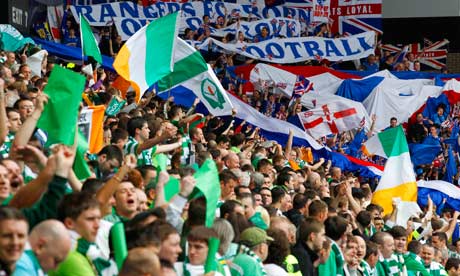
So, are they all the same? Judge for yourself. But when it comes to wrapping yourself in the iconoography of Royalty, Orange supremacy and Empire or the symbolism of Irish Republicanism, ant-fascism and Che Guevara, well, where do you think I'm going to stand?
Incidentally, the film maker says he and his crew were attacked by Rangers supporters whilst trying film - for being English - but then whoever said loyalist bigotry and racism was logical? And the footage shows they were clearly intimidated and harrassed by supporters of this team pretty much throughout their filming. Whereas the Celtic supporters shown appear to have welcomed them into their pubs and clubs warmly - albeit boisterously! That in itself I believe speaks volumes about the politics and culture of the respective support.
And you know, I dont beleive every Rangers supporter is a fascist. Well, not until there is a match on. Ive met plenty of Rangers fans who were self defining socialists, scottish nationalists, anti-racists etc. But get a few pints inthem on match day, and they will be belting out 'Billy Boy' with the best off them, drunkenly singing of how they are "up to their knees in fenian blood" and lauding the exploits of the fascist gang leader Billy Fullerton. 90 minute bigtos they may be, but a hell of a lot of damage can be done in those 90 minutes. Doesn't even take 90 seconds to cut a young boys throat.
There are those, particularly within the SNP, who claim Rangers is a part of Scotland, a part of our tradition and culture and for that it should be saved. And it may be all those things, but they are the very worst aspects of our nation and our culture, celebrating our shame, our involvement in Empire and colonisation, our lackeying and our soldiering for Englands conquests.
And Rangers provides a focus for the celebration and continuation of that. Without Rangers such views would still exists, bigotry will not die overnight, but it would no longer have a home, a hot house to nurture and grow in.
Rangers demise would be one step forward on the path to a progressive Scotland of equals.
http://www.vice.com/en_uk/
Good film documenting the rivalry and politics of the Old Firm following. Now, this is much better than I expected it to be. The premise of the English lad who made this is that essentially both sides, Celtic or Rangers, are essentially the same, just divided by an old tribal rivalry based upon religion, expressed through football. And whilst from a sociological point of view he may have a point, that is also the case between the loyalist and the republican communities in the 6 counties too. But that in itself tells you nothing. It is politics that is key here - as in most things. And the different politics of the two supports shines through here.
So, are they all the same? Judge for yourself. But when it comes to wrapping yourself in the iconoography of Royalty, Orange supremacy and Empire or the symbolism of Irish Republicanism, ant-fascism and Che Guevara, well, where do you think I'm going to stand?
Incidentally, the film maker says he and his crew were attacked by Rangers supporters whilst trying film - for being English - but then whoever said loyalist bigotry and racism was logical? And the footage shows they were clearly intimidated and harrassed by supporters of this team pretty much throughout their filming. Whereas the Celtic supporters shown appear to have welcomed them into their pubs and clubs warmly - albeit boisterously! That in itself I believe speaks volumes about the politics and culture of the respective support.
And you know, I dont beleive every Rangers supporter is a fascist. Well, not until there is a match on. Ive met plenty of Rangers fans who were self defining socialists, scottish nationalists, anti-racists etc. But get a few pints inthem on match day, and they will be belting out 'Billy Boy' with the best off them, drunkenly singing of how they are "up to their knees in fenian blood" and lauding the exploits of the fascist gang leader Billy Fullerton. 90 minute bigtos they may be, but a hell of a lot of damage can be done in those 90 minutes. Doesn't even take 90 seconds to cut a young boys throat.
There are those, particularly within the SNP, who claim Rangers is a part of Scotland, a part of our tradition and culture and for that it should be saved. And it may be all those things, but they are the very worst aspects of our nation and our culture, celebrating our shame, our involvement in Empire and colonisation, our lackeying and our soldiering for Englands conquests.
And Rangers provides a focus for the celebration and continuation of that. Without Rangers such views would still exists, bigotry will not die overnight, but it would no longer have a home, a hot house to nurture and grow in.
Rangers demise would be one step forward on the path to a progressive Scotland of equals.
http://www.vice.com/en_uk/

